
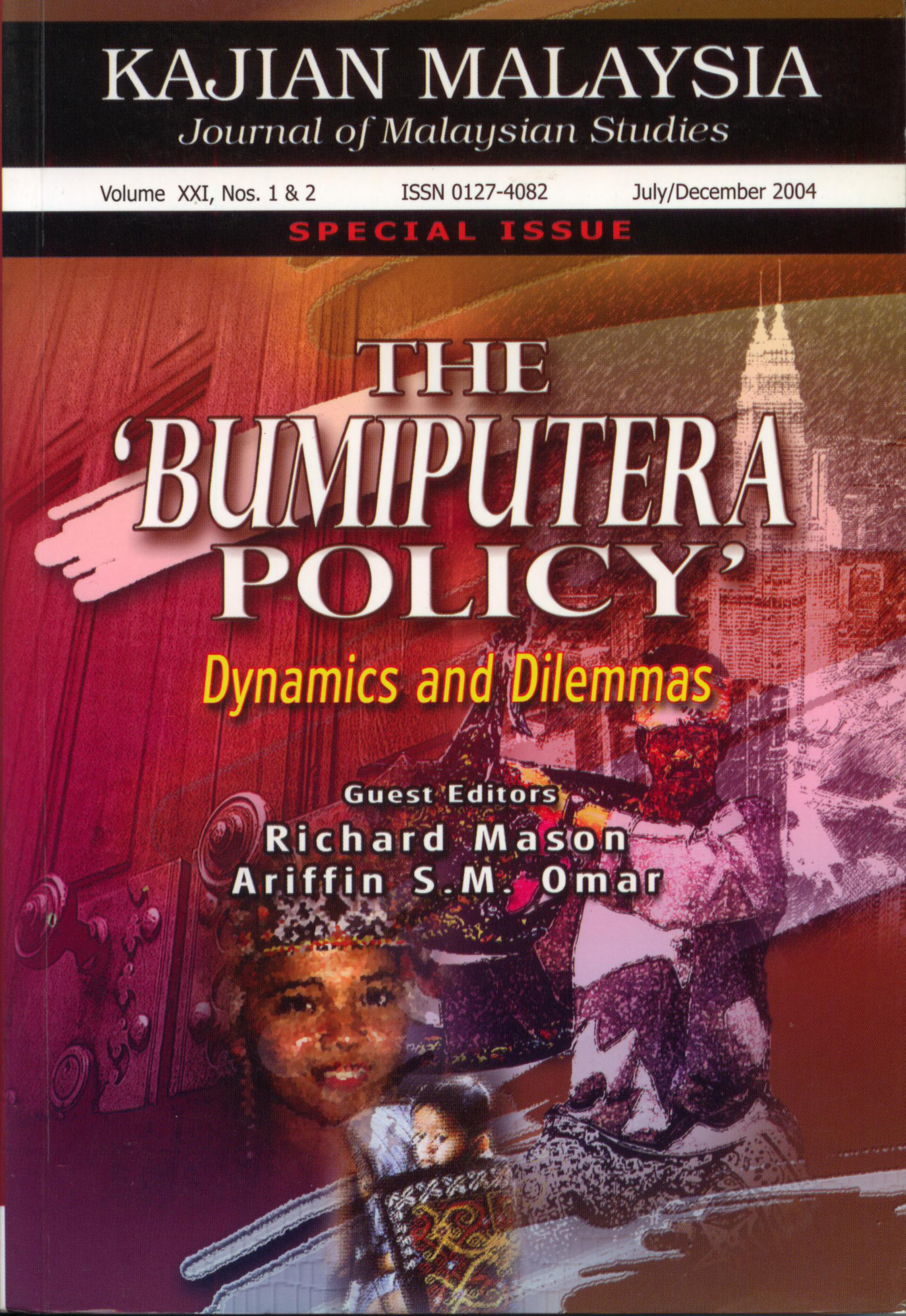
Towards the National Vision Policy: Review of the New Economic Policy and New Development Policy Among the Bumiputera Communities in Sarawak
Article Sidebar
Main Article Content
Abstract
Some observers (Torii, 1997; World Bank 1993; Chowdhury and Islam 1996; IMF 1997) of Malaysia's economic development claimed that Malaysia represent one of the success stories of a developing economy. Malaysia succeeded in reducing its incidence of poverty from 49.3 percent in 1970 to 6.3 percent in 2002 (Allaudin Anuar, 2003). According to the World Bank (1993) Malaysia occupies a unique position for three related reasons. Firstly, it is the only one of the dynamic economies of East Asia that is substantially multi-ethnic; secondly, it is one of the few open market economies to integrate commitments to poverty elimination and redistribution in its growth strategy. Another reason cited for Malaysia's success story is direct Government intervention under the twenty-year New Economic Policy (NEP), which was launched in 1971, and the ten-year New Development Policy (NDP), which covers a period from 199l-2000. As Malaysia enters into its tenyear National Vision Policy (NVP) era starting 2001, the emergence of recent events and development trends necessitate a rethinking and reexamination of both policies. This raises fundamental questions: How far have Malaysia succeeded in eradicating poverty and addressing economic inequality? The answers to this question will provide input in the formulation of the NVP and other development policies in the future.
Article Details

This work is licensed under a Creative Commons Attribution 4.0 International License.