
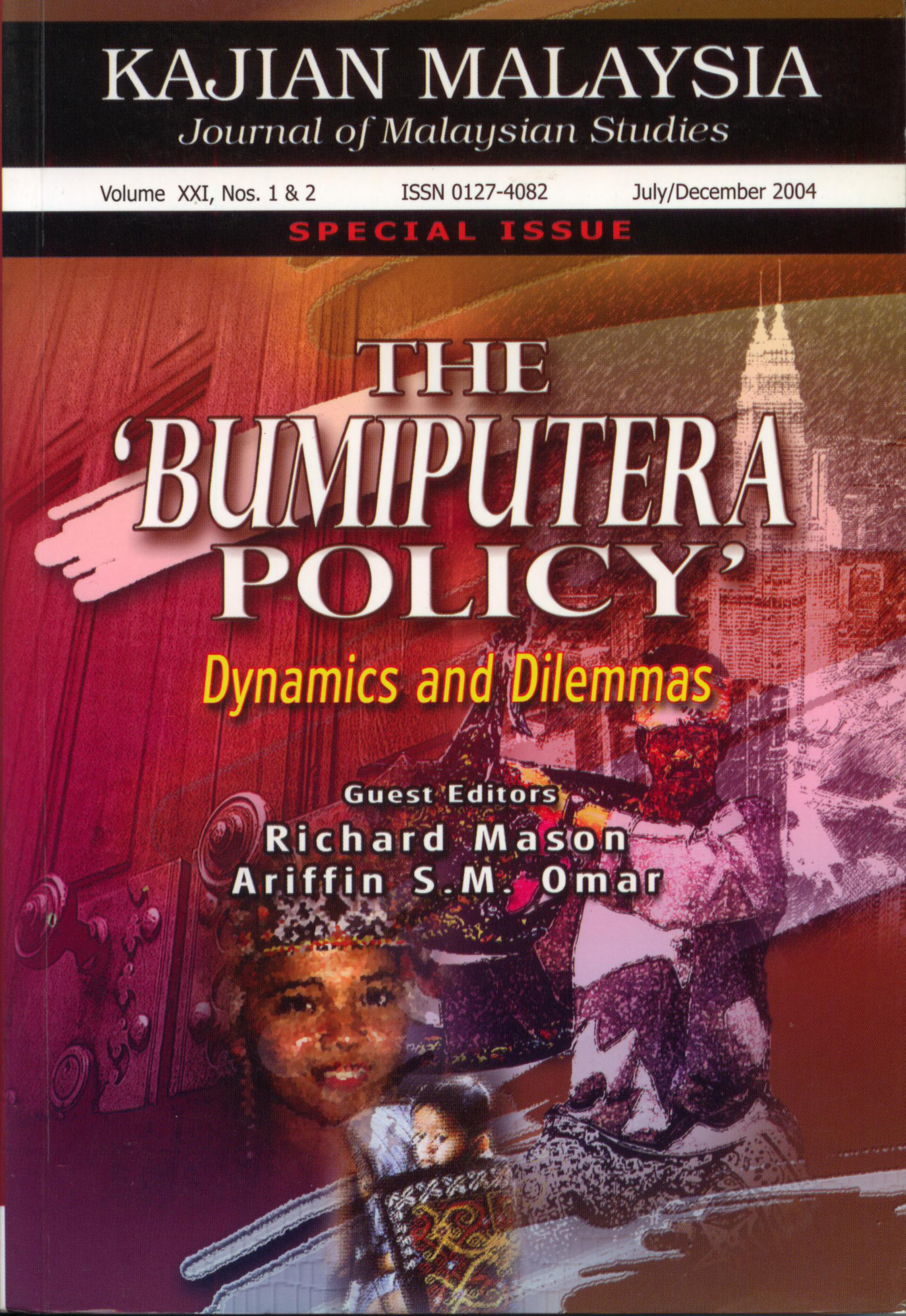
The Taqwa Versus Quwwah Dichotomy: An Islamic Critique of Development via the Malaysian Bumiputera Policy
Article Sidebar
Main Article Content
Abstract
One will not dispute the contribution made by various planks oJ' the Bumiputera Policy to the improvement in Malay economic conditions, and the consequent shift oJ'a portion oJ'the Malays to what may be termed as the'middle class'. The rapid industrialisation and modernisation oJ- a developing country have conventionqlly been associated with class shifts involving the expansion rtf'a dynamic middle class. The emergence ofa Malay middle cla,ss hecome observable with the popularisation of'the term 'New Malay' in the national prtlitical' economic lexicon o/'the 1990s. But it is questionable whether the socalled |[ew Malay is comparable to the middle class who,se dynamism historically ./uetted economic expansion' In the Malaltsian case' it is argued that under the aegis o.f the state, the New Malay has .failed to nurture competitive characteristics essentiql to withstQnd external pressures, as shown in the debacle befalling Malay businesses in 1997- 1998. This hes been in part, due to the.focus on materiul acquisition of wealth as the end in the whole package of'the Bumiputera Policy, to the neglect of other issues which are nevertheless important in building an honourable civiliscttion. The issues oJ'attitudes, motivation and mrtralit.y are some examples. It is pertinent here to cctnsider an Islamic critique o.f the Bumiputera Policy. The scope of investigation narrows dou'n towqrds unraveling the /actors for the success of the bqnned Darul Arqammovement and its defacto successor, RuJaqa'Corporation. Their success shows that, through.faith in God and religious solidarity, it is possible for Bumiputeras to assume middle class credentials without relying on state patronage. Darul Arqam and Rufaqa'formed part of the informat sector of the Malal' middle class, by which is meant the sector which elfected advancements in socio-economic terms without depending on state-conditioned networks rt' the Bumiputera Policl'. These groups, which invariablyJbcused on small and medium industries (SMIs), were criticctt of the Bumiputero Policy.for its inculcation qmong the Melavs o/' .financial dependencv on the state and its detrimentql e/jects on Molat,attitttdes and motivation.
Article Details

This work is licensed under a Creative Commons Attribution 4.0 International License.